

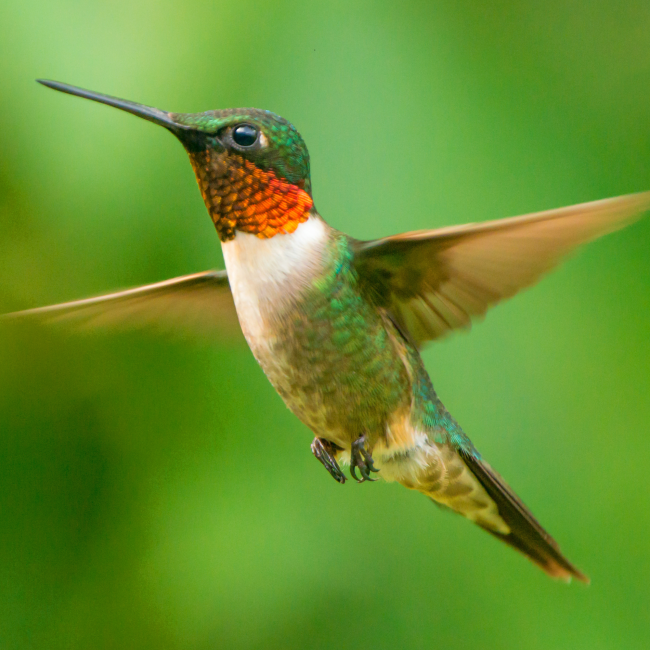
The other day I watched a hummingbird hover outside the living room window. He flew up and down, backwards and then off like a shot out of view.
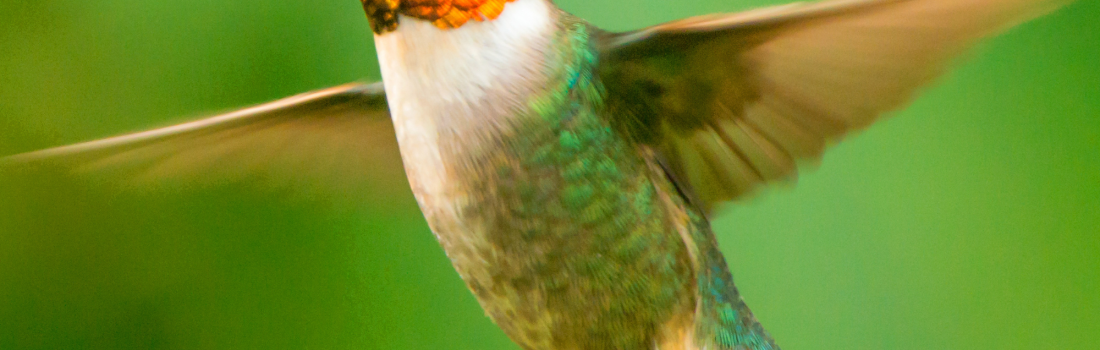
Our visitor was the ruby-throated hummingbird. It is easy to recognize. The male has an emerald, green back, a white breast and, of course, a ruby-red throat. The female looks similar except she lacks the red color on her neck. The ruby-throated hummingbird is one of the smallest birds in North America. It measures just over three inches in length and weighs but a whisper (about one-tenth of an ounce).
There is just something special about seeing a hummingbird. I think it is partly due to the incredible speed at which they move. They can fly at top speed and then stop on a dime. Hummingbirds can appear to remain motionless in midair but know that they are furiously beating their wings. The ruby-throated hummingbird can beat its wings about 53 times a second. Plus, it’s fun to watch how precisely they maneuver. They can fly up, down, sideways, and backwards.
The main food for the ruby-throated hummingbird is flower nectar. They are most attracted to flowers that fall within shades of red or orange and that are tubular in shape. This does not mean, however, that you won’t find them visiting other types of flowers. The best way to attract hummingbirds to your yard is by offering them an assortment of flowers. By including plants that bloom at different times, you will keep the hummingbirds interested all season long
There are many perennial plants that attract hummingbirds, including bee balm, Eastern red columbine, canna, hosta, trumpet vine, and cardinal flower. As a patio gardener, I also plant several annuals to attract them, such as red salvia, nicotiana, lantana, and zinnias.
Ruby-throated hummingbirds also supplement their diet with small insects, including spiders, mosquitoes, gnats, and small bees. Fortunately for gardeners, they are even known to eat aphids from plant leaves.
If you have a yard like mine with limited flowers, you can also hang a feeder to encourage hummingbird visits. Fill the feeder with a mixture of one-quarter cup of ordinary white granulated sugar per one cup of water. Growing up, we always added red food coloring to the mix, but this is not necessary. Keep the hummingbird feeder clean and change the water before it becomes cloudy. It is also a good idea to make sure your hummingbird feeder has bee guards. These are small red or yellow plastic caps that look like little grates. They fit over the feeding tubes and prevent bees from crawling into the feeder.
Ruby-throated hummingbirds arrive in spring and stay to nest. By early fall, they begin their journey back to dry tropical regions such as Mexico or Central America. While here, ruby-throated hummingbirds gorge themselves to bulk up for their long flight south. They often double their body weight in preparation for this remarkable migration.
For more information on hummingbirds, including a list of hummingbird-friendly plants, see the University of Wisconsin–Madison Division of Extension article, Hummingbirds in the Garden. Additional information on the ruby-throated hummingbird was provided by the Cornell Lab of Ornithology’s online bird guide, All About Birds.