

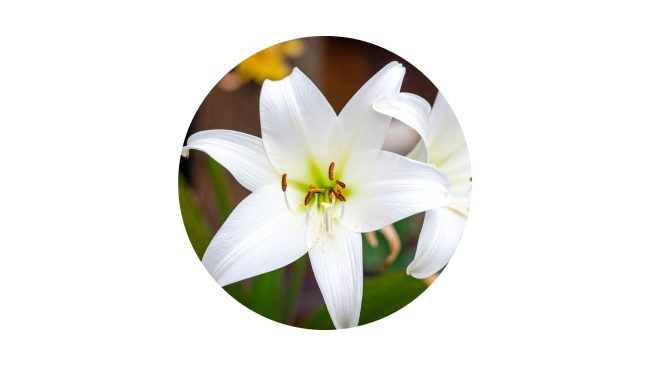
A traditional favorite, Easter lilies are often given as gifts or used in decorative displays during the weeks leading up to Easter. Throughout history their beautiful, white trumpet-shaped flowers have been a symbol of joy, hope and life.
As spring approaches, Easter lilies become widely available. Growers carefully time their blooms to coincide with Easter. If you are looking to buy one, select a plant that has flowers in different stages of bloom and appears well proportioned. The foliage should be a healthy green color and extend all the way down to the soil line. This indicates it has a good root system.
Easter lilies are easy to care for indoors. The best location is in bright, indirect light and away from drafts and heat sources that can dry them out. Keep the soil evenly moist but avoid letting the plant sit in water. Many people remove the golden-yellow anthers (pollen-bearing structures) found in the center of each flower. It’s thought that this helps to extend the life of the blossoms, but it also serves another purpose. The pollen can easily get on your clothes and stain them. It will also stain the flower’s white petals. The anthers can simply be removed as soon as the flower opens before the pollen is released. Gently twist and pull the structures free or you can cut them with some scissors. If you do get some pollen on you, don’t rub it instead remove it with the sticky side of tape.
Once the last flowers have withered, don’t throw the plant away. Instead, cut off the faded blooms leaving the foliage. Move it to a bright window and, when the threat of frost has passed, find a sunny spot and transplant it outdoors. Make sure the area is well-drained as bulbs do not like it soggy. When the leaves and stem turn brown you can remove them but don’t worry as new shoots will soon emerge. You may even be treated to a second round of flowers in late summer.
Some gardeners have good luck with overwintering the transplanted Easter lilies, but they are not reliably hardy in our area. You can try to overwinter the bulb by adding mulch after the ground freezes. If the bulb survives, you should enjoy beautiful flowers mid- to late summer, their natural bloom time.
Even though Easter lilies may be the traditional flower of Easter, you can also find hardy bulbs that have been forced into bloom right now. Arrangements of daffodils, tulips and the fragrant hyacinths are popular and can bring some wonderful spring color to your indoor space. After the hardy bulbs are done flowering, they too can be planted outside. Just cut off the flower stem (leave the leaves) and plant them in your garden beds. These bulbs won’t flower again this year but will hopefully be back next spring for you to enjoy once more.
Note: Easter lilies, and many other types of lilies, are poisonous to cats. If you think a cat has eaten a leaf, contact your veterinarian immediately.
For more information on Easter lilies, including their interesting history, see the article, Easter Lily, Lilium longiflorum, found on the UW-Madison Division of Extension Horticulture website.