

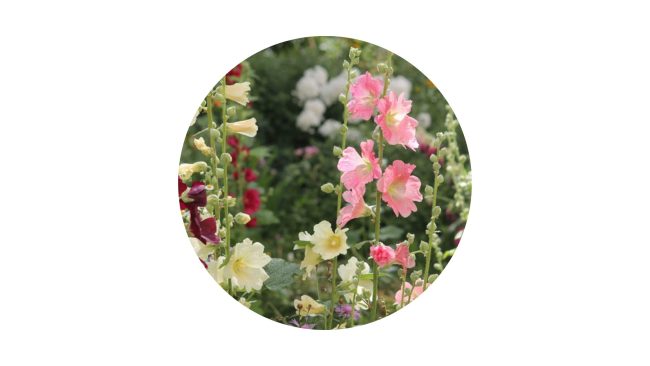
Hollyhocks are a classic flower. While they aren’t as common in gardens today, they can often still be found growing alongside older homes and on established farmsteads throughout the Midwest.
In recent years, though, there has been a renewed interest in growing hollyhocks, which makes me happy – I’ve long been a fan. As a child, I remember looking up at these towering six-foot flowers growing alongside our house, admiring their beauty and size.
My mom has always grown hollyhocks. One day, as we were looking over our garden beds, I asked why she planted them wherever we lived. She told me about the wonderful summers she and her sister spent as kids at their grandmother’s farm. Surrounding the vegetable garden was a fence lined with red-flowered hollyhocks. Ever since, she has had a great fondness for them. Mom smiled as she told me about making ‘hollyhock dolls” as a child; a craft she passed on to me and my sisters. Hollyhock dolls are made by using an unopened flower bud for the head. The ‘head’ is then attached to the stem of a fully opened blossom that serves as the skirt.
Old-fashioned types of hollyhocks are biennials, meaning they require two years to complete their life cycle. During the first year, hollyhocks establish their roots and grow a rosette of leaves at their base. In the second season, their flowers emerge. Some of the newer varieties available today are considered short-lived perennials, often lasting for a few years. In either case, hollyhocks freely reseed allowing them to live on in the garden.
There are many cultivars and heirloom varieties of hollyhocks to choose from. Red is a common color for blooms, but they come in a wide range of beautiful shades including pink, deep purple, yellow, white and even bicolored. Flowering usually begins in June and continues through the summer. Traditional hollyhocks have single flowers, but newer cultivars can be double flowered. Their large and colorful blooms make them a favorite of bees and butterflies.
Growing hollyhocks is easy. You can direct seed them in spring or late summer to produce flowering plants the next year. Plant them in a sunny location and allow enough space between plants for good air circulation. They tolerate a range of soil types but do need well-drained soil. It’s best to place them in a sheltered area out of the way of strong winds. Remove dead leaves as needed and prune out old flower stalks that are past their prime.
Hollyhocks do encounter some disease and pest problems. Rust is the most common disease to affect them. This fungal disease starts on the lower leaves producing orange to yellow spots. Dark areas may also show up on stems.
Control for rust includes removing infected leaves as soon as you notice symptoms. Clean up all fallen debris as rust will overwinter on plant litter. For more information on rust and it’s management see the University of UW Madison Division of Extension publication, Hollyhock Rust.
Hollyhocks were often used to hide unsightly areas in the yard (such as the outhouse). Today gardeners will use them as a backdrop for other plantings, vertical accents along fences or walls or for privacy screens. Since their flowers carry the meaning of “fruitfulness and abundance,” growing them might be a good luck charm for your garden.